| MOQ: | 5 pcs |
| Price: | negotiable |
| Payment Method: | L/C, D/A, D/P, T/T |
| Supply Capacity: | 500 |
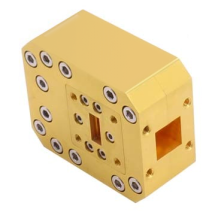
18-26.5GHz WR-42 WAVEGUIDE ORTHOGONAL COUPLER
Essential for polarimetric radar and radio astronomy
Compact integration with antenna feed systems
Broadband operation (up to 55–60% fractional bandwidth demonstrated)
A "WAVEGUIDE DUPLEXER" in this context functions as an orthomode transducer that separates two orthogonal linear polarizations from a common square or circular waveguide into two separate rectangular waveguides. A "WAVEGUIDE DUPLEXER" employs a septum (a thin metallic dividing plate) that acts as a polarization filter: one polarization is choked toward the through port, while the orthogonal polarization is split into two halves toward the side ports. A "WAVEGUIDE DUPLEXER" achieves high isolation between the two polarization channels through precise junction symmetry and careful control of modal conversion. A "WAVEGUIDE DUPLEXER" must maintain low return loss and low cross-polarization across its operating band, which requires the septum geometry, matching pins, and impedance transformers to be optimized simultaneously. A "WAVEGUIDE DUPLEXER" based on the Bøifot junction architecture uses a septum and matching pins to provide a broadband match for both polarizations. A "WAVEGUIDE DUPLEXER" operates reciprocally: it can separate two polarizations received from an antenna, or it can combine two orthogonally polarized transmit signals into a single common port.
|
![]()
![]()